
📆 The Class of 2027 College Application Timeline: Start Here
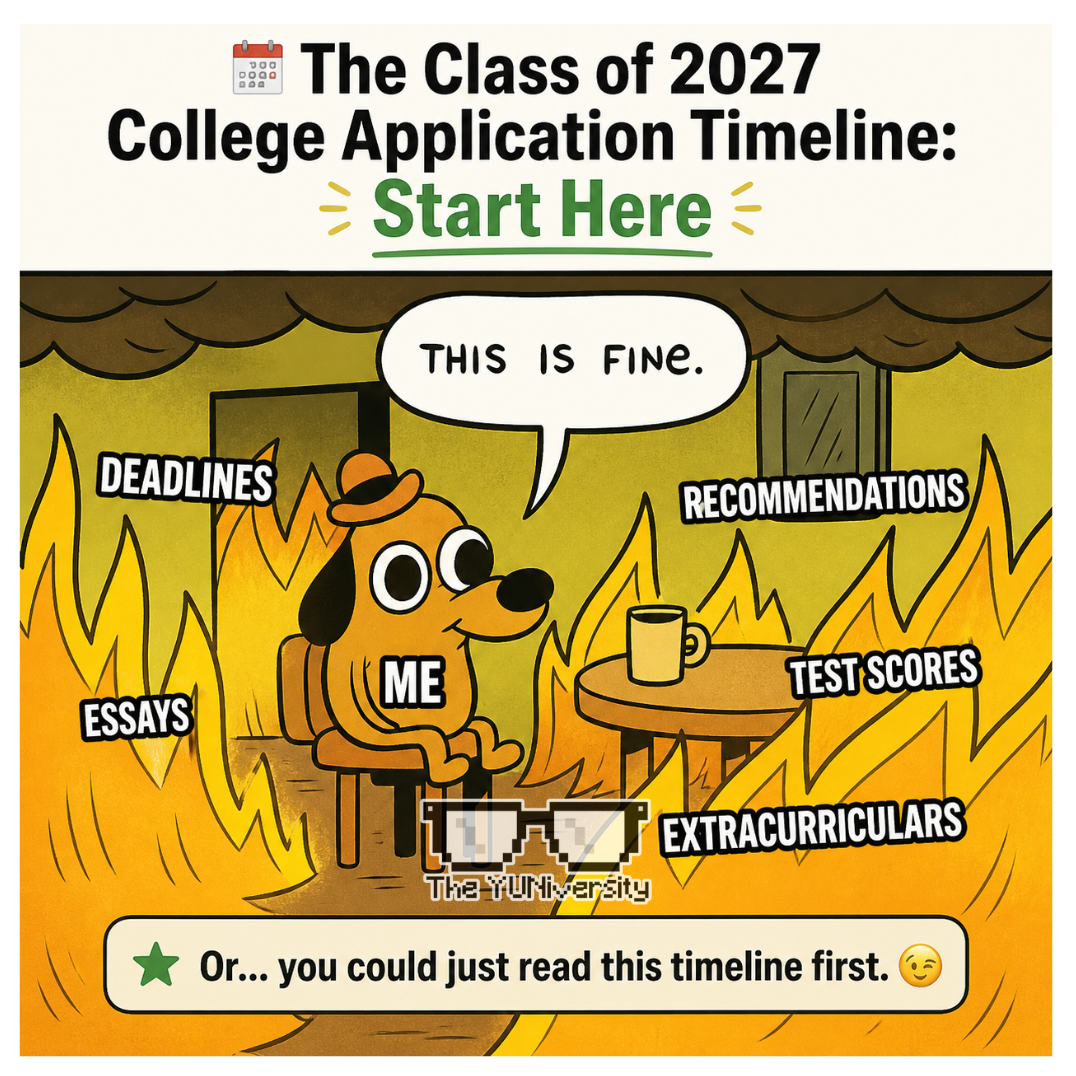
If you're finishing your junior year and college applications feel far away—they're not. The students who navigate admissions with the least stress and the strongest results are almost always the ones who started early. Here's your month-by-month roadmap.
April–May: Lay the Foundation
This is the perfect time to start thinking seriously about college without the pressure of deadlines. Begin by reflecting on what you actually want — not what your parents want, not what your friends are doing. What size school feels right? Do you want to stay close to home or go far? Are there specific programs or majors you're drawn to? Write these answers down. They'll guide everything else.
Start a simple spreadsheet to track schools you're curious about. Don't filter aggressively yet; just collect names and explore.
June: Research and Campus Visits 📍🗺️
Summer is your best window for campus visits. Schools are quieter, but admissions offices are still open and happy to give tours. Try to visit a range of schools—a big state university, a small liberal arts college, an urban campus—even if you're not sure you'd apply there. You learn a lot about your own preferences by contrast.
Use this time to research financial aid policies too. Look up whether schools on your list are need-blind, whether they meet 100% of demonstrated need, and what their average merit aid packages look like.
July: Start Your Common App 🧑🏻💻
The Common App opens August 1st, but you can start building your profile now. Fill in your basic information, activities list, and honors. More importantly, start brainstorming your personal statement. The prompt is simple on purpose: tell us something meaningful about you. The students who struggle with essays are usually the ones who wait until September. Give yourself time to write badly at first — that's how good essays happen.
August: Draft Your Personal Statement 📝
Aim to have a complete first draft of your personal statement by the end of August. It doesn't need to be perfect. It needs to exist. Share it with someone you trust (e.g., a teacher, a counselor, a parent) and get honest feedback. Then revise.
Also use August to finalize your college list. A balanced list typically has three tiers: reach schools (where your stats are below the median), target schools (where you're a strong fit), and likely schools (where you're very competitive). Aim for roughly 10 to 14 schools total.
September: Supplement Season Begins 📄
Most schools release their essay supplements in August or September. Pull them all up and read every prompt. Some schools ask for five short answers. Some ask for one long response. Knowing what's ahead lets you plan your time and avoid nasty surprises in November.
Request your letters of recommendation now if you haven't already. Give your recommenders at least six weeks—and more is always better. Provide them with a resume and a brief note about what you're hoping they'll highlight.
October: Early Decision and Early Action ⏱️
Most Early Decision and Early Action deadlines fall November 1st or November 15th. That means October is crunch time for your priority schools. Treat these applications as seriously as you would a final exam. Have every essay reviewed by at least two people before you submit.
Also register for the SAT or ACT if you plan to take it one more time. Many students take a final attempt in October or November.
November–December: Regular Decision Push 💪
After you submit your early applications, don't stop. Regular Decision deadlines are typically January 1st through February 1st, and it's easy to lose momentum after the early deadline rush. Keep writing, keep revising, keep submitting.
Check your email and application portals regularly. Schools may request additional materials, and missing those requests can hurt your candidacy.
January–March: The Waiting Game ⏳
Your applications are in … now the hard part begins. Use this time productively. Research scholarship opportunities at the schools where you've applied. If you're admitted somewhere and plan to apply for financial aid, make sure your FAFSA is submitted as early as possible (it opened in December).
Stay engaged with your senior year. Admission offers can be rescinded for significant grade drops.
April: Decisions Arrive 📩
Most Regular Decision notifications arrive between late March and mid-April. Take your time evaluating your options. Visit admitted student days if you can. Ask current students — not just admissions counselors — what they wish they had known before enrolling. Compare financial aid packages carefully; the school with the highest sticker price may end up costing less.
May 1st: Decision Day 🏁
Commit to your school, submit your deposit, and celebrate. Then send a gracious note to every teacher who wrote you a letter of recommendation. They did you a real favor.
The class of 2027 application cycle will be competitive. They all are. But students who start early, stay organized, and write authentically almost always find a school where they genuinely thrive. That's the goal: not a name on a sweatshirt, but a place where you'll grow. 🌱